Arrow Icon

Silo: A First Freelance Brief That's Still Running After a Decade.

2015
A two-room post-apocalyptic escape room — narrative, spatial layout, puzzle architecture, props, digital interactions — designed and built end-to-end for groups of up to 6 players in 60 minutes.
  • 2 Interconnected Rooms
  • 6 Parallel Puzzle Chains
  • 10+ Years in Operation
Role
Designer, Project Manager & Builder
client
Exit Games Stuttgart
service
Experience Design, Spatial Design, Game Design, Set Construction
PLATFORM
Physical Installation
Timeline
~3 Months

Context & My Role

This was my first freelance project after graduating in Media & Communication Design / Game Design from Hochschule Macromedia. The brief was open: design and build a complete escape room from scratch. I had three months and near-total creative freedom.

I pitched three storylines. The client picked a post-apocalyptic bunker — Wool, Mad Max, Fallout 4. I designed and built everything: narrative, two interconnected rooms, three puzzle chains, custom furniture, prop styling, digital game elements, wiring, and a subtle environmental guidance system.

The room opened in late 2015. It's still running today, with the core design intact.

The Silo Escape Room consists of two rooms. Players' start in the former residents living quater, trying to gain access to their target: The generator room.

The Problem

The brief came with one strong observation: in groups of 5–6 players, only two were ever actively solving. Everyone else stood around.

This wasn't a player problem — it was a structural one. Most escape rooms used a single linear puzzle chain: one puzzle unlocks the next, so whoever grabs it first solves it, and everyone else spectates.

The design challenge: keep all six players meaningfully engaged for 60 minutes.

An additional insight: cooperation deepens when sightlines are deliberately blocked. A puzzle that one player can't see alone forces communication.

Thumbnail

Puzzle layout diagram first room showing physical object/puzzle/code distribution.

The Approach

Three parallel puzzle chains in each room, designed to occupy three pairs of players simultaneously for both rooms — each chain using a different interaction type:

  • Physical — manipulating objects, levers, locks
  • Observational — reading the environment, decoding visual clues
  • Digital — code-breaking on the bunker's terminal, plus a knack-based audio puzzle

Players naturally gravitate to puzzles that match how they think. The chains converge: solving one produces a component another needs, forcing communication. The final challenge requires four inputs. No one finishes alone.

This was the architectural decision the rest of the room was built around.

A Player solving a hidden message riddle.

Starting days were mostly occupied with cleaning out the room.

My Toolbar changed from PS/Illustrator to a more physical set, including variation of filing tools.

An actual kanban door with tasks, sketches and flow descriptions of the puzzles.

Three Decisions That Shaped the Room

Subtle wayfinding through colour

Every interactive object in the room is marked with green — green containers, green tape, green covers. Players don't consciously notice. But it silently constrains the play area, reduces wasted searching, and ties to the digital terminals' Fallout-green UI. Atmospheric cohesion through a single design rule.

A 60-minute ambient soundtrack

The room runs a continuous custom soundtrack — industrial hums, subtle tension, narrative cues timed to the expected progression. Most players don't register it consciously. It shapes pacing and emotional intensity throughout. I haven't seen this approach in any other escape room since.

Costume as hidden interface

Players are issued leather jackets and motorcycle goggles — narrative dressing for the wasteland outside. What they don't know: the goggles have polarisation film in the lenses. One screen in the room has had its polarisation layer removed — invisible to the naked eye, fully readable through the goggles. The costume is the tool.

This is the moment players talk about afterwards.

A Green Ammunition Box from a "thrift-shop" players have to use.

A green border visually limited the playarea: Nothing good above the line.

Goggles prepared with polarisation film.

Striped Screen with a polarisation film test.

Embedded striped screen in the SILO.

A Final Challenge:
The Copper Generator

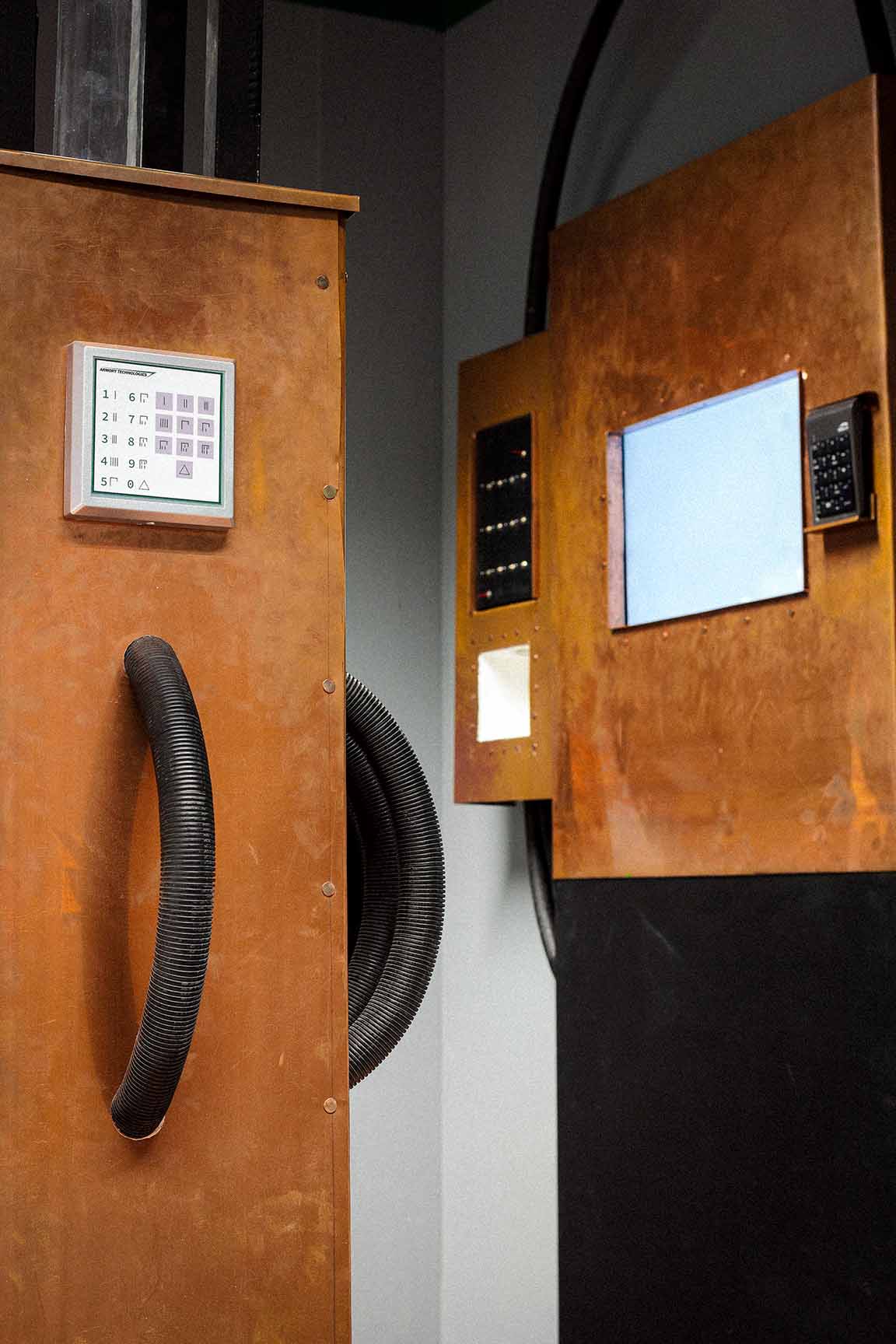
The centrepiece of Room 2 is a hand-built generator panel made from hammered copper plates — material the client inherited from his grandfather. Four combination locks light up LED indicators and finally a plasma tube and radiating ball.
It feels heavy, warm, monumental and leaves the players' with a satisfying visual conclusion.

Solving it triggers the rooms' power-on sequence — and ends the game.

Almost 50kg of copper were used as building materials throughout the room.

Building process of the copper generator: Copper sheets are hammered onto a wooden structure and fixated with copper nails.

A Sneak peek of the end-game state with the working Generator.

Silo opened end of August 2015 and was reviewed in the Stuttgarter Zeitung in December 2015. The review picked up on exactly the design intent: groups naturally splitting into pairs to work through parallel puzzles. Also on TripAdvisor Silo was  reviewed overwhelmingly positivly.

The room has been running for over 10 years. It survived a company acquisition (Exit Games → teamEscape) and a location move with the core design intact. The friend I hired as a junior assistant during construction now runs one of the company's subsidiaries, designing rooms, teambuilding workshops, and puzzle books of his own.

Ten years on, the instinct that drove this room — designing experiences where the interface disappears and the experience is what stays — runs through everything I've built since.

Result

Contact me
Project overview